Showing posts with label "Cincinnati Nature Center". Show all posts

Saturday, September 27, 2008

World Rivers Day

September 28th marks World Rivers Day, established in 2005 to promote a greater awareness of the role rivers play in our lives. Unfortunately I won't be out on a river tomorrow, since I've already made plans to attend the Ohio Renaissance Festival with friends, but I did paddle the mighty Muskingum River for sixteen miles last weekend with a good friend (pictured). The village of Dresden, Ohio held its first annual Melon Festival last Saturday along with the first annual Paddlefest.

The Muskingum River flows 111 miles through Ohio, joining the Ohio River at Marietta. The river begins at Coshocton, which is where we put in and paddled down to the historic suspension bridge at Dresden. In this section it is a broad, sleepy river, tree-lined and peaceful if one overlooks the power plant at Conesville. Bald eagles are known to nest along the river, though I didn't spot any on this trip, we were lucky enough to watch an osprey dive and catch a fish while we were having dinner later that night at Muddy Misers in Zanesville.

Tuesday, June 03, 2008

A couple of Seventeen Year Cicada photos

I hiked a couple of trails around the Cincinnati Nature Center on Sunday and spotted scads of Seventeen Year Cicadas emerging. They weren't so numerous in the woods yet but along side the meadows there were hundreds.

The newly emerged adults are cream colored before their exoskeleton hardens:


And here's an adult with the nymph shell left behind:

Tuesday, May 27, 2008

Quick Cicada Round Up


As I noted in my previous entry, I did spot a couple of early emerging seventeen-year cicadas when I was kayaking on Sunday. I also received an email from the Cincinnati Nature Center saying their cicadas are emerging and they are hosting a lecture on the insects:

Cicada Lecture at Rowe Woods
Learn all about the 17-year periodical cicadas that will be emerging this summer in Clermont County. Dr. Gene Kritsky, professor at the College of Mt. St. Joseph will share his knowledge of these unique insects.
Other Info:
Age Group:Adults
Date:5/31/2008 Time: 10:00 AM - 12:00 PM
Current/Maximum Registered: 8/50
Cost: $6; with CNC membership $4.


WCPO also posted a small entry on the east side cicadas. Can you spot what's wrong with this quote?

Kritsky says 17-year cicadas have a life span of only about two weeks.


I weep for the state of journalism in my home town.

Sunday, April 13, 2008

Late to the party

Well, I missed out on the fact that the American Ornithologist's Union had split the Canada Goose subspecies into two distinct species back in 2004. I knew the Canada Goose (pictured) had several subspecies before, mostly varying in size (smaller to the north) and coloration (darker to the west). Results from genetic analysis revealed that four of the smallest subspecies of the Canada Goose were quite distinct from the larger subspecies and the A.O.U. decided they were sufficiently different to be known as a separate species called the Cackling Goose.

The conundrum this poses for birders is well illustrated in the article The New Goose. I've no idea if I've seen this bird or not; I certainly saw tiny Canada Geese during visits to California in the past but I didn't give them much thought. On my next visit I'll be paying more attention.

Saturday, April 12, 2008

Bloodroot

Bloodroot (Sanguinaria canadensis) is blooming in our area now, but I've been thwarted in my efforts to get a decent photo this year. I have one good picture of the blossom and another of the leaf, but not both at the same time.

Bloodroot is so named because when the root is damaged it emits a blood red juice. This liquid was used by Native Americans as a dye for baskets and clothing and for painting their faces and bodies.

Although, or perhaps because, the plant has toxic properties it has long been used as a medication. Bloodroot is known to contain an escharotic, a substance that kills tissue, and the juice has been used in preparations to kill ringworm, fungal growths and warts. It is also used in mouthwashes to kill gingivitis and plaque. Despite its useful properties, self-medication is an exceedingly bad idea due to the plant's poisonous substances. It's far too lovely a plant to destroy in any case.

Sunday, April 06, 2008

Spring Ephemerals


Harbinger-of-Spring
Originally uploaded by lilysecret42
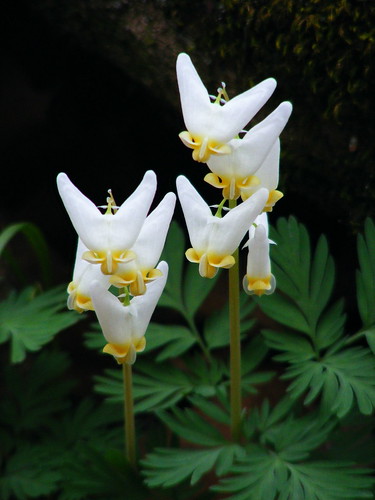
I finally ponied up the money and purchased a membership to the Cincinnati Nature Center. It's one of my favorite places to hike in the area and today I squelched my way across the two and a half mile Redwing Trail. I found lots of Harbinger-of-Spring (pictured) and Trout Lilies blooming in the woods, though it's still a week or so too early for other spring ephemeral wildflowers. Trillium, Dutchman's Breeches, Bloodroot and several others were above ground but still in bud today. We are expecting a warm week so next weekend should be peak time to take in these fleeting blossoms.

The morning started off chilly but quickly warmed as the sun rose higher into the sky. I happened to be hiking along a stream bed surrounded by a meadow when the temperature passed a certain threshold and suddenly the air was filled with the calls of Spring Peepers. That is the sort of thing that makes getting up before dark on a Sunday morning and heading out into the woods completely worthwhile.


Spring Peeper photo by Myriorama