Showing posts with label mythology. Show all posts

Sunday, January 04, 2009

Syrinx

I like to think I know a little something about birds, but even after years of study, I'm still discovering new information. I received a bookmark in the mail some weeks ago from the Cornell Lab of Ornithology which showed a picture of a Wood Thrush on one side and factoids about the bird on the other. From the bookmark:

"Thrushes have a complicated syrinx (song box) that allows them to sing two notes at the same time and harmonize with their own voice."


From the website, pertaining to all birds, not just thrushes:

"All calls and songs come from the syrinx, a unique organ in the bird's body cavity at the division of the trachea and bronchi. The elaborate syringeal muscles enhance the frequency of their songs. The syrinx consists of two independent halves that can produce two different sounds at the same time."


Pan and Syrinx by Edmund DulacIn Greek mythology, Syrinx was a nymph and a follower of Artemis, well known for her chastity. She unfortunately encountered the randy Pan whilst on a hunt and rather than submit to his attentions, cried out to her water nymph friends who turned her into a clump of reeds. Not one to waste an opportunity, Pan harvested the reeds and made a musical instrument, known today as panpipes or the syrinx.

Wood Thrush photo by Badjoby on Flickr.

Wednesday, May 21, 2008

Columbine

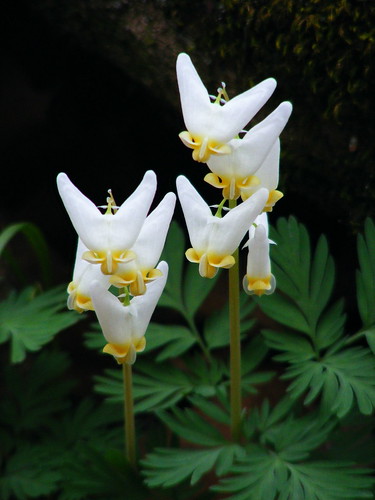
One of my favorite Ohio wildflowers blooms this time of year. The wild columbine prefers thin soils and can be found clinging to the sides of cliff faces and boulders in woodlands across Ohio. Their flowering coincides with the first arriving hummingbirds, which are well adapted to reach the nectar stored in the upper ends of the long spurs of the blossom.

The flower takes its name from columba, from the Latin word for dove. Some early aficionado thought the flower's unique shape resembled a group of doves perched around a fountain. The genus of the flower also takes its name from a bird; Aquilegia is Latin for "eagle-like" and refers to the resemblance of the flower to an eagle's talons.

In legend, the columbine is considered to be a symbol of foolishness, because the flower looks like the flounced hat of a court jester. It is considered to be bad luck to give a columbine to a woman for this reason. The wild columbine is also associated with a legend of the Virgin Mary. The fallen petals look like tiny slippers and it is said that columbine plants arose wherever Mary stepped on her way to visit her cousin Elizabeth, so sometimes columbine goes by the common name Our Lady's Shoes or the Virgin Mary's Shoes.

There are many domesticated cultivars of columbine, the flowers of most of which are upturned, but my favorite remains the lovely nodding flowers of the wild columbine. The fact that they grow in some of the prettiest spots in Ohio is probably no small factor in my preference.

Thursday, February 07, 2008

Gung Hay Fat Choy!


Happy New Year!


Today ushers in the Year of the Rat. Since I was born during a Rat year, I'm rather partial to this Chinese astrological sign. Being a Rat doesn't have the negative connotations that Westerners might associate with it. On the contrary, Rat people are thought to be charming, hard-working and intellegent, although they can also be cool, calculating, ambitious and quick to anger when threatened. The Rat happens to be the first sign in the Chinese zodiac. There are a couple of different legends as to how this came to be and they lend some insights into the nature of Rats.

Legend of the Chinese Zodiac

According to Chinese legend, the twelve animals quarreled one day as to who was to head the cycle of years. The gods were asked to decide and they held a contest: whoever was to reach the opposite bank of the river would be first, and the rest of the animals would receive their years according to their finish.

All the twelve animals gathered at the river bank and jumped in. Unknown to the ox, the rat had jumped upon his back. As the ox was about to jump ashore, the rat jumped off the ox's back, and won the race. The pig, who was very lazy, ended up last. That is why the rat is the first year of the animal cycle, the ox second, and the pig last.

From the Chinese Culture Center

In other stories the animals are summoned before either Lord Buddah or the Jade Emperor, yet the intellegent rat stows away aboard the ox and leaps onto the bank to arrive before all the other animals. An entirely different version has the Rat using trickery on his friend the Cat in order to elevate his status amongst animals:

The Rat and the Cat

A long, long time ago, the Cat and the Rat were the best of friends. They accompanied each other everywhere they went and they shared their food. One day, the Cat learnt that the Jade Emperor was going to elect twelve animals to represent the twelve calendar years, and invited all animals to a party. The Cat suggested to the Rat that both of them should make a presence.

When the day finally arrived, the Cat told the Rat, 'I am going to take a nap so that I will be in my top form. Can you please wake me up when it's time to go to the party?' 'No problem.' the Rat replied, 'Just relax and rest. I will wake you up when the time comes.'

After the Cat fell asleep, the Rat thought to himself, 'I am among the smallest of all animals and I don't stand a chance in making one of the twelve if the Cat will go.' So when the time came, the Rat left on his own without waking up the Cat, and was elected as one of the twelve Zodiac Animals.

When the Cat found out what the Rat had done, he was furious. The two became worst enemies. This is the reason why cats are not one of the twelve animals and they love to chase after rats.

From Yutopian Online

Saturday, February 02, 2008

Happy Groundhog Day!


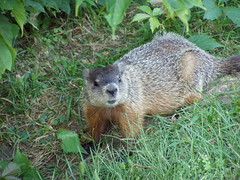
Although a lot of people regard groundhogs as nuisances, due to their habit of digging large dens which can undermine buildings or create hazards for livestock, I've always quite liked them. I enjoy seeing them emerge in the spring as a sure sign that winter is on its way out and I like watching the way they waddle about, heavy with fat, in the autumn just before they go to ground for the cold months.

Also known as woodchucks or whistle pigs, groundhogs are a large marmot, which is in turn a type of ground squirrel (again with the squirrels!) The name woodchuck comes from the Cree word wuchak, while whistle pig comes from their habit of emitting a loud, high pitched call when startled.

Groundhogs are true hibernators, retreating to an underground chamber for the duration of winter and living off stored subcutaneous fat. During hibernation, its body temperature will drop to less than 40°F (4°C), its breathing slows to once every six minutes, and its heartbeat drops from more than 100 beats per minute to four.

A solitary animal, the groundhog digs an extensive underground burrow which may have as many as five entrances, so that it is never far from a bolt hole while feeding above ground. Although they prefer an underground escape when confronted by a predator, they can both climb trees and swim well. It is perhaps due to its employment of a variety of methods to avoid becoming dinner that the groundhog has a reputation as a trickster in Native American mythology.

Origin of the Groundhog Dance

(From Myths of the Cherokee, by James Mooney)

Seven wolves once caught a Groundhog and said, "Now we'll kill you and have something good to eat." But the Groundhog said, "When we find good food we must rejoice over it, as people do in the Green-corn dance. I know you mean to kill me and I can't help my self, but if you want to dance I'll sing for you. This is a new dance entirely. I'll lean up against seven trees in turn and you will dance out and then turn and come back, as I give the signal, and at the last turn you may kill me.

The wolves were very hungry, but they wanted to learn the new dance, so they told him to go ahead. The Groundhog leaned up against a tree and began the song, Ha'wiye'ehi', and all the wolves danced out a in front, until he gave the signal, Yu! and began with Hi'yagu'we when they turned and danced back in line. "That's fine," said the Groundhog, and went over to the next tree and started the second song. The Wolves danced out and then turned at the signal and danced back again. "That's very fine," said the Groundhog, and went over to another tree and started the third song. The wolves danced their best and the Groundhog encouraged them, but at each song he took another tree, and each tree was a little nearer to his hole under a stump. At the seventh song he said, "Now, this is the last dance, and when I say Yu! you will all turn and come after me, and the one who gets me may have me." So he began the seventh song and kept it up until the wolves were away out in front. Then he gave the signal, Yu! and made a jump for his hole. The wolves turned and were after him, but he reached the hole first and dived in. Just as he got inside, the foremost wolf caught him by the tail and gave it such a pull that it broke off, and the Groundhog's tail has been short ever since.


As to the origin Groundhog Day itself, the Ohio Department of Natural Resources recorded this brief but interesting history: