Showing posts with label squirrels. Show all posts

Saturday, February 02, 2008

Happy Groundhog Day!


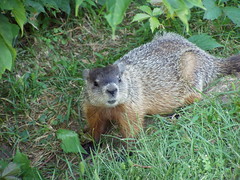
Although a lot of people regard groundhogs as nuisances, due to their habit of digging large dens which can undermine buildings or create hazards for livestock, I've always quite liked them. I enjoy seeing them emerge in the spring as a sure sign that winter is on its way out and I like watching the way they waddle about, heavy with fat, in the autumn just before they go to ground for the cold months.

Also known as woodchucks or whistle pigs, groundhogs are a large marmot, which is in turn a type of ground squirrel (again with the squirrels!) The name woodchuck comes from the Cree word wuchak, while whistle pig comes from their habit of emitting a loud, high pitched call when startled.

Groundhogs are true hibernators, retreating to an underground chamber for the duration of winter and living off stored subcutaneous fat. During hibernation, its body temperature will drop to less than 40°F (4°C), its breathing slows to once every six minutes, and its heartbeat drops from more than 100 beats per minute to four.

A solitary animal, the groundhog digs an extensive underground burrow which may have as many as five entrances, so that it is never far from a bolt hole while feeding above ground. Although they prefer an underground escape when confronted by a predator, they can both climb trees and swim well. It is perhaps due to its employment of a variety of methods to avoid becoming dinner that the groundhog has a reputation as a trickster in Native American mythology.

Origin of the Groundhog Dance

(From Myths of the Cherokee, by James Mooney)

Seven wolves once caught a Groundhog and said, "Now we'll kill you and have something good to eat." But the Groundhog said, "When we find good food we must rejoice over it, as people do in the Green-corn dance. I know you mean to kill me and I can't help my self, but if you want to dance I'll sing for you. This is a new dance entirely. I'll lean up against seven trees in turn and you will dance out and then turn and come back, as I give the signal, and at the last turn you may kill me.

The wolves were very hungry, but they wanted to learn the new dance, so they told him to go ahead. The Groundhog leaned up against a tree and began the song, Ha'wiye'ehi', and all the wolves danced out a in front, until he gave the signal, Yu! and began with Hi'yagu'we when they turned and danced back in line. "That's fine," said the Groundhog, and went over to the next tree and started the second song. The Wolves danced out and then turned at the signal and danced back again. "That's very fine," said the Groundhog, and went over to another tree and started the third song. The wolves danced their best and the Groundhog encouraged them, but at each song he took another tree, and each tree was a little nearer to his hole under a stump. At the seventh song he said, "Now, this is the last dance, and when I say Yu! you will all turn and come after me, and the one who gets me may have me." So he began the seventh song and kept it up until the wolves were away out in front. Then he gave the signal, Yu! and made a jump for his hole. The wolves turned and were after him, but he reached the hole first and dived in. Just as he got inside, the foremost wolf caught him by the tail and gave it such a pull that it broke off, and the Groundhog's tail has been short ever since.


As to the origin Groundhog Day itself, the Ohio Department of Natural Resources recorded this brief but interesting history:

Thursday, January 24, 2008

So cranky

It's been just an exhausting day, compounded by the fact that Neighbor Girl decided Wednesday night was a good night to stay up -loudly- until 4:00 AM. The topper was Neighbor Girl's Stupid Friend hollering for her outside my window at 2:30 AM. When he got no response (not surprising, since she lives on the other side of the building,) he started throwing things at my window. Who does that? He got yelled at and and Neighbor Girl got a nasty note on her door this evening. I feel like such a grump, but dammit, I did lose three hours sleep to her shenanigans.

I vegged out to Animal Planet for a little while this evening and learned a new word in the process: Patagium

pa·ta·gi·um (pə-tā'jē-əm)
n. pl. pa·ta·gi·a (-jē-ə)

1. A thin membrane extending between the body and a limb to form a wing or winglike extension, as in bats and flying squirrels.
2. An expandable membranous fold of skin between the wing and body of a bird.


[Latin patagium, gold edging on a woman's tunic, perhaps from Greek *patageion, from patagos, clatter, of imitative origin .]

pa·ta'gi·al (-jē-əl) adj.

Monday, January 21, 2008

People are going to think I have a squirrel fetish...

Everyone knows that squirrels bury nuts to store food over the winter and it's easy to observe this behavior in the fall. A scientist working in Wilkes University has found that when squirrels know they're being watched doing this, they will "pretend" to bury something about twenty percent of the time. It doesn't matter if the observer is another squirrel, a bird or a human either, they know they're being watched and start hiding invisible nuts:

Saturday, January 12, 2008

More About Squirrels and Oaks


I decided to do an "Urban Hike" today and walked around Eden Park, roughly following the route I mapped out a couple of days ago. It was quite a nice walk, but I find I really prefer trails to sidewalks. People drive too fast through the park and I found myself wanting to shake my tiny fist at them and shout at them to slow down. And get off my lawn.

I was still thinking about squirrels and oaks today, probably because I live in close proximity to both. When I took my laundry to the basement this morning (I have to go outside to do this) there was a squirrel chattering at me from the security of a hundred year old oak tree.

Every few years, oak trees produce a synchronized bumper crop of acorns, a process known as masting. The abundance of food for the squirrels in turn causes a furry population boom the following year; well fed squirrels produce more squirrel pups. In colonial times, when the forests were more extensive and less fragmented, this often led to huge mass migrations during September as the squirrels left the area in search of new territories. In 1803 Lewis and Clark witnessed one of these mass emigrations, noting squirrels swimming across the Ohio River. Lewis assumed they were moving south for the winter. Other historical records report masses of gray squirrels so dense that it would take a month for the army to pass through.

The following text was copied from this website, but I can't find the author's name, else I would attribute:

During modern times, squirrel emigrations have not been as spectacular because of the cutting and fragmentation of the vast hardwood forest does not normally allow the build up of the same size squirrel mess as previous eras. But in 1964, millions of squirrels emigrated from the north of Georgia to the south. "One squirrel was reported swimming across the Allatoona Reservoir and encountered a boat in his path. It didn’t stop him. He just ran up an oar, jumped in the boat, ran across the man in the boat, and jumped back into the water continued his swim south. Normally wild squirrels in the woods are scared of man but during migration they lose their normal fear.

In 1968, a migration of squirrels occurred in most of the eastern United States; Alabama, the Carolinas, Georgia, Maryland, New York, Pennsylvania, Tennessee and Virginia. In New York, one hundred thousand drowned squirrels were pulled out of one reservoir. The number of squirrels killed by automobiles was a thousand times as high as usual. Some estimates of the squirrels number went as high as eighty million.


Friday, January 11, 2008

Fridays shouldn't feel like Mondays

I just returned from the doctor's office, having had a mole removed from my nose. I also had a dentist appointment on Wednesday, and I have to say I'm really tired of HAVING NEEDLES STABBED INTO MY POOR HEAD. My nose is bright white where the anaesthetic is still working; it looks like the beginning stages of frost bite. I'm feeling quite abused, so I'm having a lovely Terrapin Rye Pale Ale from Athens, GA, which was a gift from Heather and Chris. (Thanks! It's really hitting the spot tonight!)

And my pepper grinder just died. It really has been one of those days. How thoughtful of Bed, Bath and Beyond to put a 20% off anything coupon in my mailbox today.

So I'm going to write about squirrels instead of the trials and tribulations of this week. Squirrels and oak trees have a deeply intertwined relationship. Squirrels rely on oaks for food in the form of acorns and the oak trees depend on the squirrels forgetting about some of their cached nuts and in turn dispersing oak seedlings far and wide. Oak forests nearly always contain both red and white oak species. The white oak has an acorn which germinates in the fall, soon after if falls to the forest floor, whereas the red oak acorns germinate in the spring. Once an acorn germinates, its food value plummets for the squirrels, and the squirrels know this. They tend to bury the red oak acorns for eating in late winter and early spring, whereas they eat more white oak acorns fresh in the fall. They do cache white oak acorns as well though, but often before doing so, they bite into the acorn and remove the embryo. This prevents the acorns from germinating, preserving their food value for the squirrels. The embryos are not removed from red oak acorns before burying in the fall, but squirrels have been observed digging up red oak acorns in the early spring, removing the acorn embryo, then re-burying the acorn for later consumption. Clever, eh?