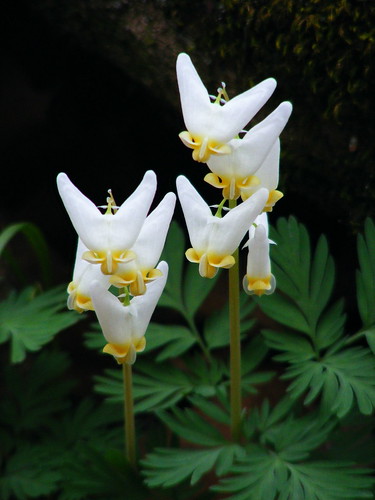
The preserve is protected by the Ohio Historical Society and there is a nearly mile long boardwalk winding through the fen. The plant life is spectacular and there were loads of wildflowers in bloom today, including Jack-in-the-Pulpit, White Trillium, Bent Trillium, Bishop's Cap, Wild Columbine, Golden Ragwort and Starry False Solomon's Seal. I'm already planning another trip in about four weeks when the Showy Lady's Slipper, one of our native orchids, will be in bloom.
Showing posts with label history. Show all posts
Showing posts with label history. Show all posts
Sunday, May 04, 2008
Cedar Bog
I'm not sure how Cedar Bog managed to elude me all the years I've been hiking around Ohio, but it had until today. It's located just outside Urbana and it's largest calcareous bog (actually a fen) in Ohio. I learned from Sally, an enthusiastic and knowledgeable guide, that a bog is a geographic formation characterized by standing water while a fen is flushed at least periodically by fresh water and therefore the soil in a fen is richer in nutrients and less acidic than that found in bogs. Cedar Bog was formed when a retreating glacier left a shallow depression in the earth at the end of the last ice age. It is home to several species of plants and animals seldom found elsewhere in Ohio, including the Massasauga Rattlesnake and the endangered Spotted Turtle.
 The preserve is protected by the Ohio Historical Society and there is a nearly mile long boardwalk winding through the fen. The plant life is spectacular and there were loads of wildflowers in bloom today, including Jack-in-the-Pulpit, White Trillium, Bent Trillium, Bishop's Cap, Wild Columbine, Golden Ragwort and Starry False Solomon's Seal. I'm already planning another trip in about four weeks when the Showy Lady's Slipper, one of our native orchids, will be in bloom.

Saturday, April 05, 2008
Posole and Hominy
 My mind has been on Mexican and Tex-Mex food since I returned from San Antonio. I came across a can of white hominy in the cupboard and so decided to try my hand at making posole for the first time. Posole is a stew, generally made from pork, hominy and chilies, served all across Mexico and the American Southwest. The first thing I discovered while searching for a recipe is that there are thousands of them. I chose a simple, reputably authentic recipe from Urban Farm Girl mostly because there were few ingredients and I had all of them on hand. I used an ancho chile along with the red chilies and I had to substitute dried, granulated garlic for fresh (I am unaccountably out of garlic and didn't want to run to the store for just that); otherwise I followed the recipe and it was delicious. I made it in my seldom-used cast iron dutch oven; I'm thinking this would be a good dish to make over a campfire.
Not only was it the first time I tried posole, but it was the first time I ever had hominy either. What can I say, I haven't spent much time in the American South. I really liked it and I'm sorry I missed out on it all these years. The texture surprised me somewhat. It kept its integrity throughout a rather lengthy cooking process - almost more like a bean; fresh sweet corn wouldn't have held up nearly so well after cooking for two hours in a dutch oven.
Hominy is dried maize which has been treated with an alkali to remove its tough outer hull, through a process known as nixtamalization. Nixtamalization has been practiced since at least 1200 BC, the earliest archaeological evidence having been found in Guatemala. The process is crucial to not only removing the tough outer hull, but to unlocking the nutrients within the large, starchy grain. Alton Brown's episode of Good Eats - Tort(illa) Reform talked about this process in some detail and a portion of the transcript follows:
Transcript courtesy of Good Eats Fan Page
Once upon a time in 1519, a certain Spanish businessman/adventurer named Hernando Cortez landed in what is today Veracruz, Mexico. Why? Because he had a serious hankering for gold, which he soon found heaps of in the Aztec city-state of Tenochtitlán, which was, at the time, probably the most splendid city on earth.
Figuring he would be a far better steward of all that wealth, Cortez aided by cannons, horses, smallpox, and a legend that made him out to be a returning god, captured the city's ruler, Montezuma, and set about decimating one of the greatest civilizations our planet has ever hosted. Had Cortez stopped just for a moment to consider how it was that such heathen savages were able to erect such a bling-encrusted metropolis, he might have discovered a very different kind of gold altogether ...
SCENE 4
The Kitchen
GUEST: Deb Duchon, Nutritional Anthropologist
AB: ... maize. You know, the average Meso-American diet was very corny indeed. But unlike the sweet field corn we modern North American Anglos know and love, the stuff the Aztec lived on was very very starchy and came with a very thick outer hull, or pericarp, okay? Now, probably 10,000 years or so before Columbus showed up, these early Americans learned that if they...
DD: ... if they soaked and cooked the maize in water with wood ashes in it, that the hulls would just slip right off.
AB: You notice how I don't even have to think "nutritional anthropologist" anymore, and she shows up?
AB: Okay, I'll bite. What's with the wood ashes?
DD: They're alkaline, of course.
AB: Ah. Well, that certainly explains why, last summer, when I left all those ashes in my grill, and it rained a bunch, the bottom of the grill corroded out.
DD: I remember that. But today's Mexican cooks don't use wood ashes anymore. They use cal.
AB: Oh, short for calcium hydroxide, a.k.a. slaked lime. It's used in the construction business to help concrete harden.
DD: But the really fascinating thing about it was that the Meso-Americans thought they were just removing the pericarp, but what they were actually doing was setting in motion this miraculous and amazing phenomenon.
AB: I sure hope you're not about to launch into one of your long soliloquies without the benefit of a visual aid.
DD: Well, check this out then.
AB: Okay.
DD: The miracle of nixtamal... [DD clicks a remote and a large cage descends]
AB: Whoa. Wow, what a sweet visual metaphor representing the many nutrients locked away inside a kernel of corn. Hah, think I'll have a little proline. Hey, what gives? I can't get any of them out.
DD: Nixtamalization is like a chemical key that unlocks all the wonderful nutrients that are locked inside a kernel of maize.
AB: So what kind of nutrients are we talking about here?
DD: Well, for one thing, amino acids like lysine and tryptophan. But most importantly, vitamin B3 better known as niacin. Now if the Aztecs hadn't had nixtamalization, they wouldn't even have the energy to build that magnificent empire of theirs. And once Cortez showed up, he probably wouldn't even have paid much attention to them. He certainly had no reason to destroy their empire like he did.
AB: Got it.
DD: But in a way, they got their revenge, because when Cortez and the other conquistadores brought maize back to the Old World, they didn't take nixtamalization.
AB: Yeah.
DD: So the countries and peoples that adopted corn as their main grain soon suffered from a terrible disease of malnutrition called pellagra.
AB: What's pellagra do?
DD: The three dreaded Ds: diarrhea, dementia, and death.
AB: Well, I guess that's Montezuma's real revenge.
Friday, April 04, 2008
Mike Fink
 I'm not sure how I managed to live in a river city for forty some years without hearing or reading stories about Mike Fink. I knew of the riverboat by that name of course; I've even had a couple of meals there. But I never gave a second thought as to who Mike Fink was until I came across the name in a history of the Alamo yesterday.
Mike Fink was the known as "The Last of the Boatmen", one of those men who made their living navigating the large rivers of the American interior before the days of steam powered paddle-wheelers. He was a semi-legendary figure, born in the late 1700s in Pittsburgh, Pennsylvania to French-Canadian parents. The reason his name appeared in the Alamo history I read was because he was supposed to have crossed paths with Davey Crockett, who described Fink as "half horse and half alligator." All accounts describe his being a keen shot with a rifle, hard-drinking, popular with the ladies and possessing both a quick wit and a bad temper. For further edification, click the link below.
Friday, March 28, 2008
San Antonio's Riverwalk
 San Antonio's Riverwalk is a tourist attraction done right. Descending a flight of stairs from street level leads you into two and a half mile series of pathways that border the small green San Antonio River, which is plied by flatboats filled with laughing people. There are only two methods of transportation on the Riverwalk - your feet and the boats. The Riverwalk is lined with more restaurants and hotels than I could count, interspersed with splashing fountains, arched foot bridges and ancient bald cyprus trees. The Riverwalk is also famous for its music scene and there is no shortage of places to kick back with a cocktail while listening to live jazz.
The Riverwalk was designed by a young architect by the name of Robert H.H. Hugman in 1929. His plan was not put into action until 1939 however, when the WPA undertook construction. It was completed only two years later, concluding with the first annual Fiesta River Parade, featuring floats that actually float.
Thursday, March 13, 2008
Alder Catkins
Somehow I managed to walk four and a half miles today - a workday no less. The weather was sunny and in the sixties and I couldn't stay inside. I spent my two breaks during the day doing laps around the office building (five laps equals one mile) and after work I went over to Sharon Woods and walked all the way around Sharon Lake.
There are many alder trees bordering the lake and they are already in bloom. This photo depicts long catkins, which are the male flowers of this tree. You can also see the woody remains of the female catkins from last year, still clinging to the tree. They look like tiny pine cones.
Alder trees are water loving and their oily wood is found throughout Venice, Italy in underwater foundations and pilings. It was also commonly used to build bridges. The wood does not rot in water, instead becoming hard as stone. Alder trees are also very useful in environmental reclamation projects, as the nitrogen fixing nodules on their root system improve soil fertility.
Wednesday, March 05, 2008
Another one of those days
in which I am too tired to type very much. So, speaking of typing, I leave you with a Brief (but fascinating) History of the Typewriter.


Wednesday, February 27, 2008
What the Vikings were wearing back in the day
 I've been interested in historical food and dress for many years. It's what makes history come alive for me - understanding what people where eating, drinking, wearing and doing for fun, rather than just knowing what war was going on or who sat on the throne at any given place and time. So I read with interest an article published on LiveScience about a Viking woman's costume found in a grave 10th century grave in Russia, though unfortunately the article doesn't say where in Russia (and it's a rather large place). The reproduction of the dress shows a brightly colored silk garment worn trailing behind and joined in the front by two metal breast shields. It must have been a costly garment, considering the bright blue color and the fabric, which was silk.
Before the invention of synthetic dyes fabrics in bright colors, such as deep blue, purple and bright red, were very expensive and therefore indicative of rank and wealth. Purple has long been associated with royalty for this very reason; the cost of harvesting this dye (collected from a marine mollusk) was so vast that the resulting cloth was out of reach for all but the wealthiest of people. The fact that this Viking garment was made from silk also indicates wealth as the cloth (or the fibers themselves) could only have come from China, a journey of many hundreds of miles.
Monday, February 25, 2008
Tumbling Tumblers
After a ten hour workday (on a Monday no less) I'm not much inclined to write anything. Therefore I leave a link that relates to one of my earlier posts regarding the origin of the tumbler. Amanda Clark discusses naughty, round bottom shot glasses that were all the rage during prohibition over at Serious Eats.
Thursday, February 21, 2008
Future Music Festival

I found out today that the Loveland Castle, Chateau Laoche will be hosting a music festival and farmer's market June 13th through the 15th. They are raising money to put a new roof on the old castle. It's a most worthy cause and I plan on attending provided I'm in town. It's just so freaking cool to have an honest-to-goodness castle nearby.
The people from England can stop pointing and laughing at me now.
Monday, February 18, 2008
Fava Bean Love
 So, it turns out I actually like fava beans, when they're prepared properly. It seems I somehow missed the fact that the beans have a tough, leathery skin that needs to be removed before eating. No wonder I didn't like them before. I'm amazed that more recipes for fava beans don't mention this rather crucial fact and I feel a bit of an idiot for not figuring it out for myself sooner. I only cottoned on after I read a thread on Chowhound regarding favas. By the way, Chowhound is an excellent resource for anyone with cooking and/or food questions. Now that they've fixed the thread search function you can get all sorts of useful information.
I soaked the beans overnight in plenty of water, then removed the skins. They came off quite easily after soaking. After that I followed this recipe for ful medames and the result was quite delicious, in my humble opinion.
Fava beans are Europe's only indigenous bean and have been cultivated since the Iron Age. In ancient Greece and Rome, fava beans were used in voting; a black bean represented a 'no' vote, with a white bean indicating a 'yes' vote. The 6th century B.C. Greek philosopher Pythagoras (he of the Pythagorean theorem) reviled the fava bean and forbade his followers from eating them. He thought that the beans contained the souls of the dead. His superstitious dread may have resulted from witnessing favism, which is a hereditary disease. Individuals who lack the gene for producing the enzyme G6PD (which assists in oxygenating red blood cells) risk severe illness and even death by kidney failure and hemolytic anemia after eating fava beans. The genetic susceptibility to death by fava bean is most concentrated in Mediterranean populations; the vast majority of people have nothing to worry about when eating fava beans. Which is fortunate, as they are quite tasty when handled correctly.
Photo from benketaro on Flickr
Saturday, February 02, 2008
Happy Groundhog Day!
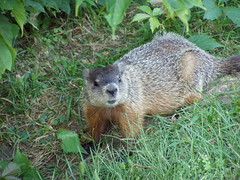
Although a lot of people regard groundhogs as nuisances, due to their habit of digging large dens which can undermine buildings or create hazards for livestock, I've always quite liked them. I enjoy seeing them emerge in the spring as a sure sign that winter is on its way out and I like watching the way they waddle about, heavy with fat, in the autumn just before they go to ground for the cold months.
Also known as woodchucks or whistle pigs, groundhogs are a large marmot, which is in turn a type of ground squirrel (again with the squirrels!) The name woodchuck comes from the Cree word wuchak, while whistle pig comes from their habit of emitting a loud, high pitched call when startled.
Groundhogs are true hibernators, retreating to an underground chamber for the duration of winter and living off stored subcutaneous fat. During hibernation, its body temperature will drop to less than 40°F (4°C), its breathing slows to once every six minutes, and its heartbeat drops from more than 100 beats per minute to four.
A solitary animal, the groundhog digs an extensive underground burrow which may have as many as five entrances, so that it is never far from a bolt hole while feeding above ground. Although they prefer an underground escape when confronted by a predator, they can both climb trees and swim well. It is perhaps due to its employment of a variety of methods to avoid becoming dinner that the groundhog has a reputation as a trickster in Native American mythology.
Origin of the Groundhog Dance
(From Myths of the Cherokee, by James Mooney)
Seven wolves once caught a Groundhog and said, "Now we'll kill you and have something good to eat." But the Groundhog said, "When we find good food we must rejoice over it, as people do in the Green-corn dance. I know you mean to kill me and I can't help my self, but if you want to dance I'll sing for you. This is a new dance entirely. I'll lean up against seven trees in turn and you will dance out and then turn and come back, as I give the signal, and at the last turn you may kill me.
The wolves were very hungry, but they wanted to learn the new dance, so they told him to go ahead. The Groundhog leaned up against a tree and began the song, Ha'wiye'ehi', and all the wolves danced out a in front, until he gave the signal, Yu! and began with Hi'yagu'we when they turned and danced back in line. "That's fine," said the Groundhog, and went over to the next tree and started the second song. The Wolves danced out and then turned at the signal and danced back again. "That's very fine," said the Groundhog, and went over to another tree and started the third song. The wolves danced their best and the Groundhog encouraged them, but at each song he took another tree, and each tree was a little nearer to his hole under a stump. At the seventh song he said, "Now, this is the last dance, and when I say Yu! you will all turn and come after me, and the one who gets me may have me." So he began the seventh song and kept it up until the wolves were away out in front. Then he gave the signal, Yu! and made a jump for his hole. The wolves turned and were after him, but he reached the hole first and dived in. Just as he got inside, the foremost wolf caught him by the tail and gave it such a pull that it broke off, and the Groundhog's tail has been short ever since.
As to the origin Groundhog Day itself, the Ohio Department of Natural Resources recorded this brief but interesting history:
Subscribe to:
Posts (Atom)