Showing posts with label words. Show all posts
Showing posts with label words. Show all posts
Monday, February 25, 2008
Tumbling Tumblers
After a ten hour workday (on a Monday no less) I'm not much inclined to write anything. Therefore I leave a link that relates to one of my earlier posts regarding the origin of the tumbler. Amanda Clark discusses naughty, round bottom shot glasses that were all the rage during prohibition over at Serious Eats.

Monday, February 11, 2008
Look Before You Leap
Today I learned that that BASE, as in BASE jumping, stands for Bridge, Antennae, Span and Earth. I didn't know it was meant to be capitalized so I never noticed the acronym before. I just assumed "base" meant a stable platform, as opposed to an airplane, which of course it does.
Sadly, the reason I learned this is because this guy BASE jumped off the Perrine Bridge over the Snake River Canyon in Idaho. His jump was successful, but he'd evidently neglected to make sure he knew the way out of the canyon beforehand and died of exposure after getting lost. It just goes to show, having an exit strategy is a crucial part of any major plan.
Closer to home, we are under a winter storm advisory and it's actually snowing this time. I am mounting a defense; a hearty pot of kale and white bean ragout to stave off the chill.
Sadly, the reason I learned this is because this guy BASE jumped off the Perrine Bridge over the Snake River Canyon in Idaho. His jump was successful, but he'd evidently neglected to make sure he knew the way out of the canyon beforehand and died of exposure after getting lost. It just goes to show, having an exit strategy is a crucial part of any major plan.
Closer to home, we are under a winter storm advisory and it's actually snowing this time. I am mounting a defense; a hearty pot of kale and white bean ragout to stave off the chill.
Friday, February 08, 2008
Faience
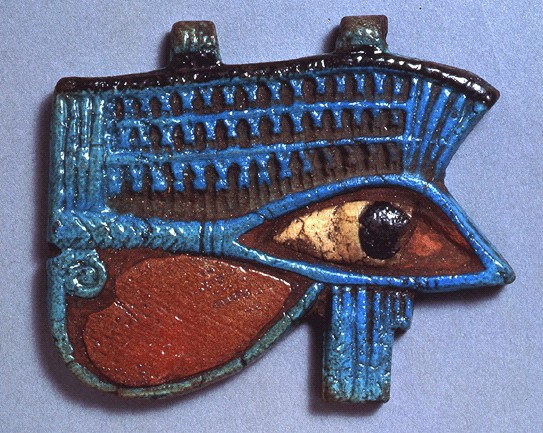 I broke down and purchased Immortal Cities: Children of the Nile tonight, which is an ancient Egyptian city builder computer game. I've long been partial to city builders: Caesar, Pharaoh, Emperor, I've played them all. In Children, one of the city shops is an artisan who sells faience jewelry. I vaguely remember purchasing "mummy beads" at the Cincinnati Art Museum when I was a kid and I seem to remember the word faience associated with them. I also remember the beads had a peculiar smell to them, not unpleasant but odd and undefinable for me at the time.
Faience, as it turns out, is the oldest manufactured artificial substance, first produced (probably in Egypt) around 5,500 years ago. It is a non-clay ceramic substance, primarily composed of crushed quartz or silica mixed with lime, soda or ash, which is finished by glazing and firing in a kiln. In ancient Egypt, faience was used to produce many different types of objects, from beads and jewelry to figurines and pottery. The typical color of a finished piece was a lovely blue-green due to the copper used in the glaze, although many other colors of glazed faience were also produced.
The only place traditional faience is still being made is in Iran; the modern Egyptian version is mostly made from soapstone for the tourist trade. This makes it unlikely in the extreme that my 50 cent strand of "mummy beads" was actually faience. In fact, they may have been made of some sort of resinous material, which would account for the odor. I'd love to have some again and I always look for "mummy beads" whenever I go into a museum gift shop now, but I haven't managed to find any.
Thursday, January 24, 2008
So cranky
It's been just an exhausting day, compounded by the fact that Neighbor Girl decided Wednesday night was a good night to stay up -loudly- until 4:00 AM. The topper was Neighbor Girl's Stupid Friend hollering for her outside my window at 2:30 AM. When he got no response (not surprising, since she lives on the other side of the building,) he started throwing things at my window. Who does that? He got yelled at and and Neighbor Girl got a nasty note on her door this evening. I feel like such a grump, but dammit, I did lose three hours sleep to her shenanigans.
I vegged out to Animal Planet for a little while this evening and learned a new word in the process: Patagium
pa·ta·gi·um (pə-tā'jē-əm)
n. pl. pa·ta·gi·a (-jē-ə)
1. A thin membrane extending between the body and a limb to form a wing or winglike extension, as in bats and flying squirrels.
2. An expandable membranous fold of skin between the wing and body of a bird.
[Latin patagium, gold edging on a woman's tunic, perhaps from Greek *patageion, from patagos, clatter, of imitative origin .]
pa·ta'gi·al (-jē-əl) adj.
I vegged out to Animal Planet for a little while this evening and learned a new word in the process: Patagium
pa·ta·gi·um (pə-tā'jē-əm)
n. pl. pa·ta·gi·a (-jē-ə)
1. A thin membrane extending between the body and a limb to form a wing or winglike extension, as in bats and flying squirrels.
2. An expandable membranous fold of skin between the wing and body of a bird.
[Latin patagium, gold edging on a woman's tunic, perhaps from Greek *patageion, from patagos, clatter, of imitative origin .]
pa·ta'gi·al (-jē-əl) adj.
Subscribe to:
Posts (Atom)